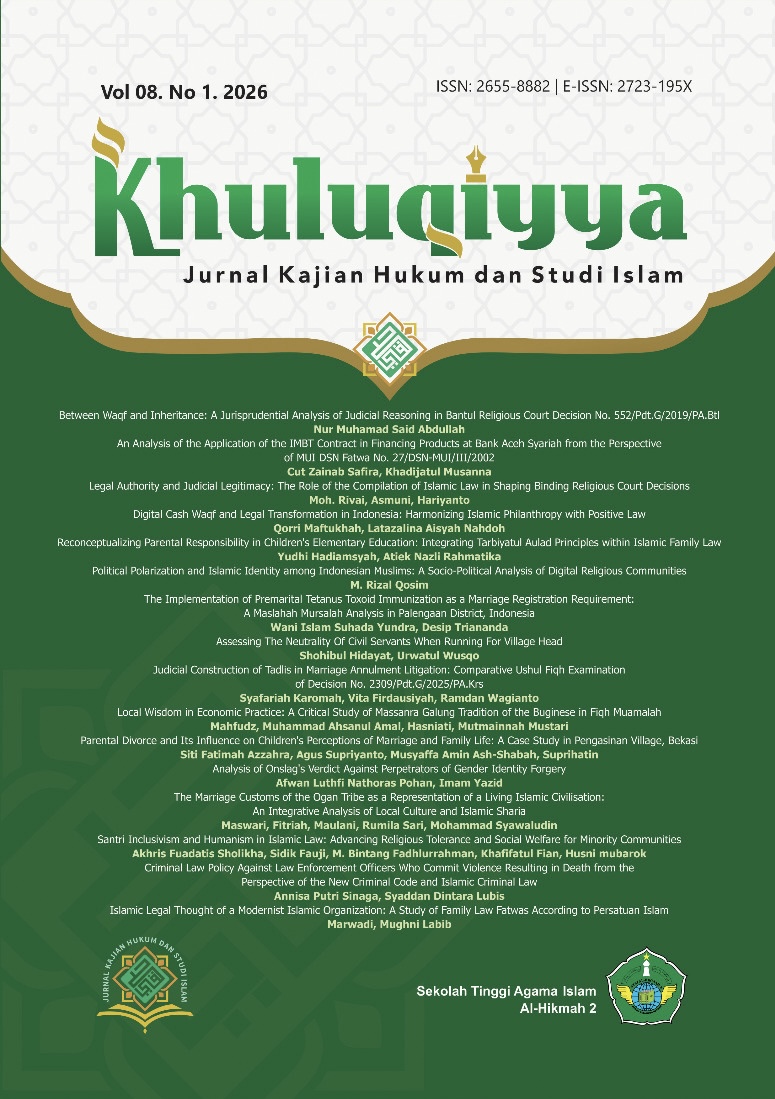
Political Polarization and Islamic Identity among Indonesian Muslims: A Socio-Political Analysis of Digital Religious Communities
DOI:
https://doi.org/10.56593/khuluqiyya.v8i1.217Keywords:
Political Polarization, Islamic Identity, Digital Religious Communities, Indonesian MuslimsAbstract
This study examines the relationship between political polarization and the construction of Islamic identity among Indonesian Muslims within the context of digital religious communities. The rapid development of digital communication technologies and social media platforms has significantly transformed patterns of religious interaction, political participation, and identity formation in contemporary Muslim societies. Digital religious communities have emerged as influential spaces where religious interpretations, political narratives, and ideological preferences are continuously negotiated and disseminated. This research aims to analyze how political polarization shapes the formation and expression of Islamic identity in online communities and how digital environments contribute to reinforcing or transforming socio-political attitudes among Indonesian Muslims. Using a socio-political approach, this study explores the interaction between religious discourse, political affiliation, and digital engagement within virtual communities. The analysis suggests that digital religious spaces function not only as platforms for religious expression but also as arenas of political contestation that may intensify ideological divisions and strengthen group-based identities. At the same time, these platforms provide opportunities for dialogue, participation, and the emergence of new forms of religious and political engagement. The study contributes to contemporary discussions on Islam, politics, and digital society by highlighting the evolving relationship between religious identity and political dynamics in Indonesia's increasingly interconnected digital landscape.
Downloads
References
Abusharif, Ibrahim N. “Religious Authority, Digitality, and Islam: The Stakes and Background.” Journal of Islamic and Muslim Studies 8, no. 1 (May 2023): 109–19. https://doi.org/10.2979/jims.00010.
Arifin, Firdaus, Rosa Tedjabuwana, Subelo Wiyono, and Mohd Kamarulnizam Abdullah. “Indonesia’s Identity Politics and Populism: Disruption to National Cohesion.” Jurnal Civics: Media Kajian Kewarganegaraan 22, no. 1 (March 13, 2025). https://doi.org/10.21831/jc.v22i1.1291.
Bukhari, Bukhari, Bastiar Bastiar, Muhammad Hatta, Iswandi Iswandi, and Muhammad Diah. “Islam, Religious Moderation, and Digital Political Polarization: Religious Authority and Social Cohesion in the Age of Social Media.” Lentera 7, no. 2 (December 3, 2026): 201–12. https://doi.org/10.32505/lentera.v7i2.14433.
Burhanuddin, Agussalaim, Andi Ahmad Yani, Amril Hans, Andi Rahmat Hidayat, and Muhammad Pudai. “Socio-Religious Preferences of the Indonesian Youths in Digital and Everyday Life.” Journal of Southwest Jiaotong University, 2021.
Creswell, John W, and J David Creswell. Research Design: Qualitative, Quantitative, and Mixed Methods Approaches. Sage publications, 2017.
Damanik, Deniansyah, Ahmad Rezy Meidina, Ridlo Adlinnas, and Shofie Nurul Azizah. “Religious Moderation By Organization Of Islamic Al-Jam’iyatul Washliyah (Character, Identity, And Attitude).” Islamadina : Jurnal Pemikiran Islam 24, no. 2 (September 22, 2023): 233. https://doi.org/10.30595/islamadina.v24i2.17089.
Faizin, Barzan. “Polarization of Religious Issues in Indonesia’s Social Media Society and Its Impact on Social Conflict.” Journal of Applied Data Sciences 6, no. 1 (January 1, 2024): 426–42. https://doi.org/10.47738/jads.v6i1.447.
Handoko, Gatot Repli, and Swastiningsih Swastiningsih. “The Role of Political Communication in Addressing Polarization and Identity Politics in Indonesian Democracy.” Journal of Law and Humanity Studies 2, no. 2 (2025): 62–67.
Haryanto, Sindung. “The Sociological Context of Religion in Indonesia.” In Research in the Social Scientific Study of Religion, Volume 30, 67–102. BRILL, 2019. https://doi.org/10.1163/9789004416987_006.
Helena Octavianne, Fendy Suhariadi, Mohammad Fakhruddin Mudzakkir, Donny Trianto, and Umar Chamdan. “Identity Politics and Polarization in Contemporary Muslim Countries: The Impact of Elections, Social Media, and Global Dynamics.” MILRev: Metro Islamic Law Review 3, no. 2 (December 16, 2024): 263–86. https://doi.org/10.32332/milrev.v3i2.9909.
HERDIANSAH, ARI GANJAR, LUTHFI HAMZAH HUSIN, and HENDRA HENDRA. “Religious Identity Politics on Social Media in Indonesia: A Discursive Analysis on Islamic Civil Societies.” Jurnal Studi Pemerintahan 9, no. 2 (2018). https://doi.org/10.18196/jgp.2018.0186.187-222.
Hudianto, huwaidatul izza. “The Dynamics of Identity Politics Polarization in the 2017 Jakarta Gubernatorial Election.” Journal of Political Islam 1, no. 2 SE-Articles (September 30, 2025). https://journal.unesa.ac.id/index.php/jopi/article/view/41085.
Karmila, L, A Rachmiatie, D FARDIAH, D AHMADI, and A S MUHTADI. “The Role of Social Media in the Political Construction of Identity: Implications for Political Dynamics and Democracy in Indonesia.” Journal of Infrastructure, Policy and Development 8, no. 14 (2024): 9171.
Khadiq. “Transformation of Islamic Religious Practices in the Digital Era.” Jurnal Dakwah 24, no. 2 (December 30, 2023). https://doi.org/10.14421/jd.2023.24205.
Khamis, Sahar. “The Paradoxes of Modern Islamic Discourses and Socio-Religious Transformation in the Digital Age.” Religions 15, no. 2 (2024): 207.
Lohlker, Rüdiger, and Soleh Hasan Wahid. “The Transformation of Islamic Religious Authority.” Religions 17, no. 4 (2026): 493.
Mohiuddin, Asif. “Islamism in the Digital Age: The Role of Cyberspace in Transforming Religious Authority.” In Navigating Religious Authority in Muslim Societies, 203–36. Cham: Springer Nature Switzerland, 2023. https://doi.org/10.1007/978-3-031-44825-6_6.
Muhamad Najib Aulia Zaman, Muhammad Syakur, Joni, Muh. Baehaqi, Sumarjoko, and Husna Nashihin. “The Challenges of Internalizing Religious Moderation Values amid the Rise of Socio-Political Polarization.” At Turots: Jurnal Pendidikan Islam 6, no. 1 SE-Articles (January 3, 2026): 625–31. https://doi.org/10.51468/jpi.v6i1.1380.
Muhdi Ali, Awan Farih, Sholahuddin Al Ayubi, and Andi Rosa. “Transforming Religious Authority: Islamic Epistemology in the Digital Age.” RUSYDIAH: Jurnal Pemikiran Islam 6, no. 1 SE-Articles (August 19, 2025): 19–37. https://doi.org/10.35961/rsd.v6i1.2079.
Nibrosu Rohid, Rahma Sugihartati, Bagong Suyanto, Daniel Susilo, and Afriul Zikri. “Digital Activism in Contemporary Islamic Politics: A Critical Analysis of Social Media’s Impact on Islamic Movements.” MILRev: Metro Islamic Law Review 4, no. 1 (April 2025): 208–33. https://doi.org/10.32332/milrev.v4i1.10159.
Pabbajah, Mustaqim. “Religious Disorientation in the Digital Transformation: An Islamic Review.” In Advances in Digital Transformation-Rise of Ultra-Smart Fully Automated Cyberspace. IntechOpen, 2024.
Parinduri, M Azmi Alkhosyi Parinduri. “Parallel Struggles of Religious Moderation Activists Amid Hindu-Muslim Tensions in India and Political Polarization in Indonesia.” Social Impact Journal 4, no. 2 (2025): 283–95.
Rachman, Arief, Theguh Saumantri, and Taufik Hidayatulloh. “Transformation of Religious Authority in the Digital Era: A Post-Normal Times Analysis by Ziauddin Sardar on the Phenomenon of Social Media Da’wah.” Jurnal Ilmu Dakwah 45, no. 1 (July 6, 2025): 107–22. https://doi.org/10.21580/jid.v45.1.25644.
Ramadhani, Luthfiyah. “The Role of Social Media in Strengthening Religious Moderation Amidst Digital Politics in Indonesia.” Social Impact Journal 4, no. 2 (2025): 251–59. https://doi.org/https://doi.org/10.61391/sij.v4i2.214.
Ramli, Muhammad Haikal. “The Paradox of Secularization: The Dynamics of Religious Moderation and Identity Politics in Indonesia.” Social Impact Journal 4, no. 2 (2025): 296–306.
Rifki, Lalu Rifki Rahman. “Political of Religion in Digital Era.” JURNAL PENELITIAN KEISLAMAN 21, no. 1 (July 14, 2025): 66–80. https://doi.org/10.20414/jpk.v21i1.12691.
Seitakhmetova, Natalya, and Sholpan Zhandossova. “THE INFLUENCE OF DIGITALIZATION ON RELIGIOUS IDENTITY: SOCIO-POLITICAL CONTEXT.” Eurasian Research Journal 7, no. 1 (2025): 61–71. https://dergipark.org.tr/en/pub/erj/article/1631058.
Sindung Haryanto, Sindung. “The Sociological Context of Religion in Indonesia.” KONINKLIJKE BRILL NV, LEIDIN, 2020, n.d.
Solikhudin, Muhammad, Ahmad Rezy Meidina, Ahmad Zayyadi, Ashima Faidati, Ikhdan Gimas Shufyansyah, Muhammad Fuad Zain, and Nur Faizah. “Political-Legal Strategies in Regulating Interfaith Marriage: An Analysis of Supreme Court Circular Letter in Indonesia.” Jurnal Ilmiah Al-Syir’ah 22, no. 2 (December 31, 2024): 262. https://doi.org/10.30984/jis.v22i2.3237.
Solikhudin, Muhammad, Irzak Yuliardy Nugroho, Moh. Faizur Rohman, Ahmad Rezy Meidina, and Ashima Faidati. “National Fiqh and Maqasid-Based Ijtihad: Reassessing Ahmad Hasyim Muzadi through Jamal Al-Din ‘Atiyyah.” Mawaddah: Jurnal Hukum Keluarga Islam 3, no. 2 SE-Articles (n.d.): 383–405. https://doi.org/10.52496/mjhki.v3i2.38.
Suhardi, Asmara Juana. “The Impact of Identity Politics in Elections on Social Polarization in Urban Indonesian Communities.” Journal of the American Institute 2, no. 8 (July 29, 2025): 1105–14. https://doi.org/10.71364/zwezgj35.
Supandi, Supandi, and Kurratul Aini. “THE ROLE OF ISLAMIC EDUCATION IN BUILDING RELIGIOUS MODERATION IN THE ERA OF SOCIAL POLARIZATION AND DIGITAL POLITICS.” Al-Ulum Jurnal Pemikiran Dan Penelitian Ke Islaman 12, no. 4 (2025): 333–40.
UBAID, AHMAD HASAN, and H.B HABIBI SUBANDI. “Political Polarization Based on Religious Identities: Empirical Evidence from the 2017 Jakarta Gubernatorial.” Jurnal Studi Pemerintahan 8, no. 4 (2017). https://doi.org/10.18196/jgp.2017.0054.411-441.
Wahid, Soleh Hasan, and Syahid Abdulloh. “Digital Islamic Authority: A Revolutionary Shift or Mere Hype? A Systematic Review.” SN Social Sciences 6, no. 2 (February 4, 2026): 62. https://doi.org/10.1007/s43545-026-01328-5.
Warburton, Eve. “DEEPENING POLARIZATION AND DEMOCRATIC DECLINE IN INDONESIA.” Political Polarization in South and Southeast Asia. Old Divisions, New Dangers. Carnegie Endowment for International Peace, May 27, 2020. http://www.jstor.org/stable/resrep26920.8.
Wijaya, H R, Ahmet Demir, and Eva Janssen. “REIMAGINING ISLAMIC CIVILIZATION IN THE DIGITAL AGE: TECHNOLOGY, AUTHORITY, AND THE TRANSFORMATION OF RELIGIOUS MEANING.” International Jornal of Noesantara Islamic Studies 3, no. 2 SE-Articles (April 23, 2026): 98–111. https://doi.org/10.70177/ijonis.v3i2.3416.
Downloads
Published
How to Cite
Issue
Section
License
Copyright (c) 2026 Rizal Qosim

This work is licensed under a Creative Commons Attribution-ShareAlike 4.0 International License.