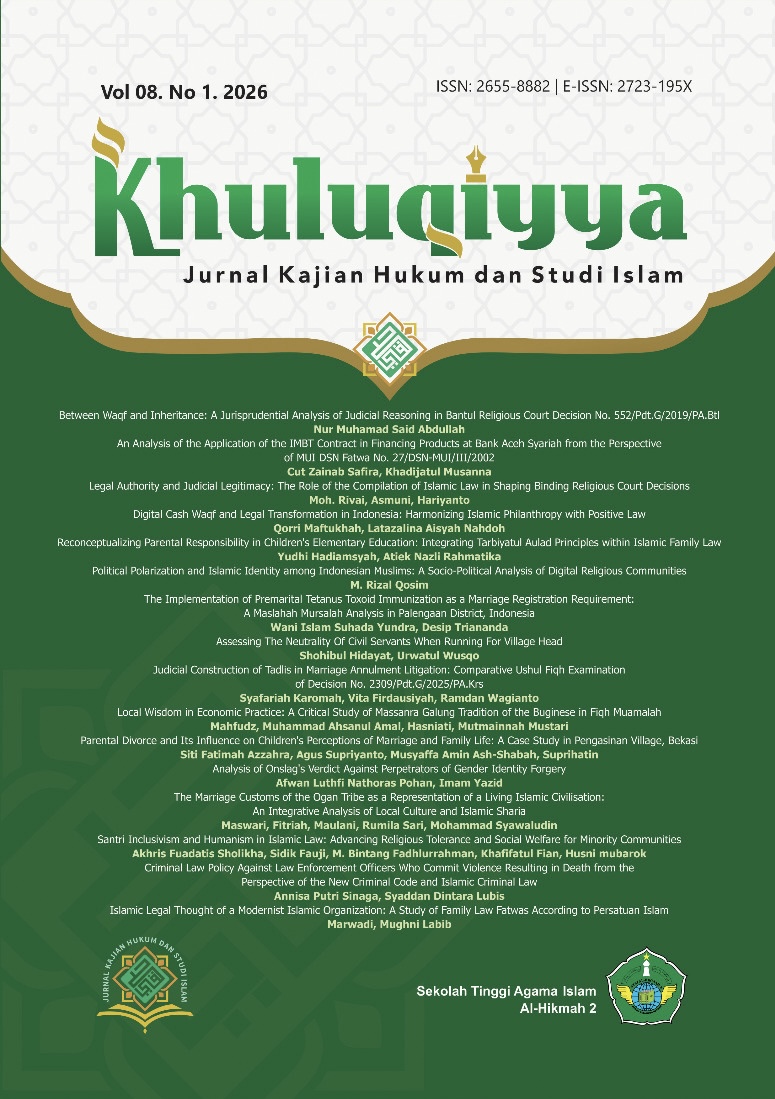
Parental Responsibility in Elementary School Children's Education: Integration of the Tarbiyatul Aulad Concept and Islamic Family Law
DOI:
https://doi.org/10.56593/khuluqiyya.v8i1.206Keywords:
Parental Responsibility, Tarbiyatul Aulad, Islamic Family Law, Elementary EducationAbstract
This study examines the gap between the normative demands of parental responsibility in children's education according to the concepts of Tarbiyatul Aulad and Islamic Family Law and the reality of its implementation in Islamic elementary schools (SD/MI), as well as exploring responses to the GEMAR program. The novelty of this research lies in three aspects: (1) the integration of Abdullah Nashih Ulwan's seven educational dimensions with Article 80 of the Compilation of Islamic Law (KHI), which has previously been interpreted only in economic terms; (2) the first evaluation of the GEMAR program in Islamic elementary schools (madrasah ibtidaiyah); (3) the development of a normative-empirical integration model that has not existed in previous studies. This research employed a qualitative approach with a single case study design. Data were collected through in-depth interviews (18 parents, 6 teachers, 1 principal, 8 students), participatory observation, and documentation. The findings indicate: (1) the ideal concept encompasses seven aspects and five educational methods, as well as the mandate of Article 80 KHI; (2) implementation remains partial, with psychological and sexual education being neglected and minimal paternal involvement (the fatherless phenomenon at only 26.7%); (3) the GEMAR program shows positive contributions but still faces challenges in the form of symbolic participation. The contributions of this research include expanding the interpretation of Article 80 KHI, critiquing gender constructs in Islamic family law, and providing evidence-based policy recommendations for the GEMAR program. In conclusion, synergy among family, school, and government is essential, emphasizing the revitalization of the father's role and the dissemination of Ulwan's seven aspects. Policy implications are context-specific and require further multi-site testing.
Downloads
References
Abd Karim, Nur Kareelawati, Dini Farhana Baharudin, and Suhailiza Hamdani. “Developing an Early Childhood Islamic Education Content Based on the Concept of Tarbiyatul Awlad.” ON EARLY CHILDHOOD DEVELOPMENT(ICECD 2019), 2019, 81.
Aini, Sri Mawaddatul. “The Role of Islamic Education Teachers in Shaping Students’ Islamic-Based Character at SDN 2 Montong Beter.” Journal of Islamic Religious Studies 2, no. 3 (2025): 246–64.
Akbar, Sika Raemif, and Sri Hidayati. “INTEGRATION OF ISLAMIC PARENTING AND FAMILY COUNSELING: A STRATEGY TO CREATE A MODERN SAMARA FAMILY.” International Journal of Multidisciplinary Reseach 1, no. 3 (2025): 11–22.
AM ZA, M Barni. “Islamic Family Education in the Contemporary Era: Integrating Tarbiyah, Ta’lim, and Ta’dib in the Formation of Muslim Children’s Character.” Al-Ilmiya: Jurnal Pendidikan Islam 1, no. 3 SE-Articles (n.d.): 636–40. https://journal.al-afif.org/index.php/al-ilmiya/article/view/350.
Ani, Sulhani, Paujan Azim, M Azik, Nu Sopyah, and Badriyah. “The Transformation of Hadhanah in the Digital Era: Islamic Parenting Strategies with Technology.” NALAR FIQH: Jurnal Hukum Islam 15, no. 2 SE-Articles (December 3, 2024): 87–99. https://doi.org/10.30631/nf.v15i2.1687.
Arie Rakhmat Riyadi, Arie, and Arie Rakhmat Riyadi. “Pedagogic Fundamental Structure of Kuttab Al-Fatih as a Model of Islamic Prophetic Based Elementary Education.” In Proceedings of the 5th International Conference on Education and Technology (ICET 2019). Paris, France: Atlantis Press, 2019.
https://doi.org/10.2991/icet-19.2019.127.
Arvyan, Ariq, and Teguh Dwi Cahyadi. “Parents’ Responsibilities Towards Children in the Era of Society 5.0 in the Perspective of Islamic Family Law in Indonesia.” Majapahit Journal of Islamic Finance and Management 5, no. 3 SE-Articles (August 16, 2025): 2410–2427. https://doi.org/10.31538/mjifm.v5i3.502.
Az-Zubair, MK Banu. “Who Is a Parent? Parenthood in Islamic Ethics.” Journal of Medical Ethics 33, no. 10 (October 2007): 605–9. https://doi.org/10.1136/jme.2005.015396.
Behrouz, Andra Nahal. “Transforming Islamic Family Law: State Responsibility and the Role of Internal Initiative.” Colum. L. Rev. 103 (2003): 1136.
Bukhari, Bukhari, Bastiar Bastiar, and Anwar Anwar. “Challenges of Parenting in the Digital Era: A Review from the Perspective of Islamic Family Law.” Al-Qadha : Jurnal Hukum Islam Dan Perundang-Undangan 11, no. 2 (December 2, 2024): 357–270. https://doi.org/10.32505/qadha.v11i2.9549.
Creswell, John W, and J David Creswell. Research Design: Qualitative, Quantitative, and Mixed Methods Approaches. Sage publications, 2017.
Farida, Nurul, and Zuhairi Zuhairi. “Qur’anic Pedagogical Methods in Islamic Child Education.” Education and Learning 1, no. 1 (2025): 10–15.
Fauzi, Ahmad Akbar, Muh Nur Rochim Maksum, and Triono Ali Mustofa. “Child Education in the Digital Era: An Analysis of the Concept of Tarbiyah According to Al-Ghazali,” 2025.
Ghina Nadia. “The Concept of Ta’dib Syed Muhammad Naquib Al-Attas in Children’s Moral Education: A Family-Based Philosophical Study.” Al-Ishlah: Jurnal Pendidikan Islam 23, no. 2 (November 29, 2025): 82–92. https://doi.org/10.35905/alishlah.v23i2.14708.
Hariyanto, Hariyanto, Ahmad Rezy Meidina, and Mabarroh Azizah. “Decentralization and the Fulfilments of Children’s Rights: Challenges and Opportunities for Local Government in Indonesia.” Lex Scientia Law Review 8, no. 2 (November 30, 2024): 677–706. https://doi.org/10.15294/lslr.v8i2.14373.
Hasan, Aliah Bagus Purwakania, Sudi Raharjo, and Sholih Khudin Anam. “Children Islamic Leadership According to Abdullah Nashih Ulwan: Forming Islamic Characters Through Story Telling.” Journal of Social Science and Education Research 3, no. 1 (January 14, 2026): 42–51. https://doi.org/10.59613/jitir.v3i1.30.
Hidayah, Muhammad Nuur. “The Concept of Moral Education for Children According to Kitab Tarbiyatul Aulad.” At-Tarbawi: Jurnal Kajian Kependidikan Islam 7, no. 1 (June 30, 2022): 27–34. https://doi.org/10.22515/attarbawi.v7i1.4549.
Isnaini, Hanna Fadhillah. “Parental Obligations in the Qur ‘an from a Maqasid Alshariah Perspective.” In INTERNATIONAL CONFERENCE ON EDUCATION, PEACE, AND SOCIAL JUSTICE, 1:171–84, 2025.
Kosim, Muhammad, Martin Kustati, Ilman Nasution, Jum Anidar, Rezki Amelia, and Suci Ramadhanti Febriani. “A MODULE ON ISLAMIC-BASED PARENTING EDUCATION FOR YOUTH FAMILY DEVELOPMENT: EDUCATING MUSLIM TEENAGERS FOR FUTURE SUCCESS.” Jurnal Ilmiah Islam Futura 24, no. 2 (August 1, 2024): 261. https://doi.org/10.22373/jiif.v24i2.20315.
Latif, Adri, Muhammad Arief Ridha Rosyadi, and Ahmad Rezy Meidina. “Jaminan Kesejahteraan Istri Dan Anak Perspektif Al-Qur’an.” Al-Bayan: Jurnal Ilmu Al-Qur’an Dan Hadist 6, no. 1 (January 11, 2023): 85–101. https://doi.org/10.35132/albayan.v6i1.258.
Listiarini, Sri, and Irwan Abdullah. “Reconstructing The Meaning Of Education: An Exploration of the Homeschooling Experience Among Families in Yogyakarta, Indonesia.” In Proceedings International Conference on Education Innovation and Social Science, 499–511, 2023.
Meidina, Ahmad Rezy, Zezen Zainul Ali, Mega Puspita, Hilma Nur Ashlakha, and Anisatuz Zahro. “What an Important Implementation of the Educational Rights of Adopted Children in Indonesia from an Islamic Jurisprudence Perspective?” El-Aqwal : Journal of Sharia and Comparative Law, May 31, 2024, 85–96. https://doi.org/10.24090/el-aqwal.v3i1.11125.
Muhammad, Syafik, Fi’liatul Laili, Hilma Nur Ashlakha, and Ahmad Rezy Meidina. “The Impact of the Family Values Crisis on Children’s Right to Education: An Islamic Legal Principles Perspective in Addressing the Challenges of the Modern Era.” El-Aqwal : Journal of Sharia and Comparative Law, June 2, 2025, 17–34. https://doi.org/10.24090/el-aqwal.v4i1.13600.
Multazam, Umar, and Akhmad Roja Badrus Zaman. “The Mubadalah Approach to Parental Rights and Obligations in Childcare According to Islamic Law.” Journal of Mujaddid Nusantara 1, no. 2 (June 30, 2024): 46–58. https://doi.org/10.62568/jomn.v1i2.139.
Nizam Ubaidilah, and Asmaul Husna. “Regulation of Maintenance in Islamic Family Law: Implications for Family Welfare.” International Journal of Health, Economics, and Social Sciences (IJHESS) 5, no. 4 SE-Articles (October 30, 2023): 601~612. https://doi.org/10.56338/ijhess.v5i4.6639.
Permana, Dian, Usman Abu Bakar, and Ahmad Mufrod Teguh Mulyo. “Child Education in Islam: A Study of Abdullah Nashih ‘Ulwan’s Thoughts in Tarbiyatul Aulad Fil Islam from the Perspective of Axiology and the Rahmatan Lil ‘alamin Curriculum.” Jurnal Ilmu Pendidikan Dan Sains Islam Interdisipliner, 2025, 222–35. https://doi.org/https://doi.org/10.59944/jipsi.v4i4.652.
Purnama, Sigit. “Abdullah Nashih ‘Ulwan’s Technological Contribution toward the Development of Islamic Early Childhood Education.” Jurnal Pendidikan Islam 7, no. 1 (August 13, 2018): 47–77. https://doi.org/10.14421/jpi.2018.71.47-77.
Putra, Dedisyah, Martua Nasution, and Disry Desky. “THE IMPACT OF DIVORCE IN CONTEMPORARY ISLAMIC LAW: CHILDREN’S RIGHTS AND PARENTS’ OBLIGATIONS AFTER DIVORCE.” Al-Mawarid Jurnal Syariah Dan Hukum (JSYH) 7, no. 2 (September 5, 2025): 301–26. https://doi.org/10.20885/mawarid.vol7.iss2.art6.
Sa’dijah, Chalimatus, and Khaerul Umam. “APPLICATION OF PROPHETIC PARENTING IN MAINTAINING FAMILY RESILIENCE: A THEMATIC AND CONTEXTUAL HADITH APPROACH.” Edukasi Islami: Jurnal Pendidikan Islam 15, no. 02 (2026): 851–70. https://doi.org/https://doi.org/10.30868/ei.v15i02.10210.
Selinah, Selinah, Hairunnas Hairunnas, and Tohirin Tohirin. “ANALYSIS OF FAMILY ISSUES FROM A PSYCHOLOGICAL PERSPECTIVE AS AN EFFORT TO RECONSTRUCT ISLAMIC FAMILY LAW IN INDONESIA.” Hukum Islam 25, no. 1 (August 12, 2025). https://doi.org/10.24014/hi.v25i1.37554.
Siregar, Siti Hasbiyah. “Islamic Education in the Tarbiyatul Islamiyyah Perspective.” Al-Murabbi Jurnal Pendidikan Islam 4, no. 1 (January 1, 2026): 1–14. https://doi.org/10.62086/al-murabbi.v4i1.1132.
Siti Nurjanah, Ahmad Syarifudin, Muhammad Mujib Baidhowi, Elva Mahmudi, and Hidayat Darussalam. “Children’s Rights in Islamic Law: A Contemporary Study of Family Practices.” MILRev: Metro Islamic Law Review 4, no. 2 (July 1, 2025): 933–53. https://doi.org/10.32332/milrev.v4i2.10077.
Sofiandi, Aldi, Wawan Irwansyah, Wiranti Wiranti, Irwan Irwan, and Nia Maulina. “EXPLORE THE FOUNDATIONS AND PRINCIPLES OF ISLAMIC FAMILY LAW.” ANAYASA : Journal of Legal Studies 1, no. 2 (January 31, 2024): 168–77. https://doi.org/10.61397/ays.v1i2.107.
Sucipta, Muhammad Aufakumara, Djamaluddin Perawironegoro, and Firman Facatle. “The Internalization Values of Prophetic Love in Akidah Akhlak Textbook: A Content Analysis for Supporting Adolescent Religious Identity Formation.” HEUTAGOGIA: Journal of Islamic Education 5, no. 2 (December 14, 2025): 225–38. https://doi.org/10.14421/hjie.2025.52-07.
Yaakob, Siti Falihah Binti, Tengku Sarina Aini Binti Tengku Kasim, Nor Fahimah Binti Mohd Razif, and Iman Mohammed Zaid Al Maawali. “Knowledge and Teaching Practices Among Secondary Islamic Education Teachers on Female Blood Fiqh: A Contextual Learning Approach.” Millah: Jurnal Studi Agama 24, no. 2 (2025). https://doi.org/10.20885/millah.vol24.iss2.ar9.
Yasin, Redwan, Nurul Hidayat Abdul Rahman, Sayuti Ab. Ghani, and Mohamed Belal. “GUARDIAN’S RESPONSIBILITY FOR THE WELFARE OF CHILDREN IN MARRIAGE: A STUDY ACCORDING TO ISLAMIC LAW.” Malaysian Journal of Syariah and Law 12, no. 3 (December 31, 2024): 778–89. https://doi.org/10.33102/mjsl.vol12no3.765.
Downloads
Published
How to Cite
Issue
Section
License
Copyright (c) 2026 Yudhi Hadiamsyah, Atiek Nazli Rahmatika

This work is licensed under a Creative Commons Attribution-ShareAlike 4.0 International License.