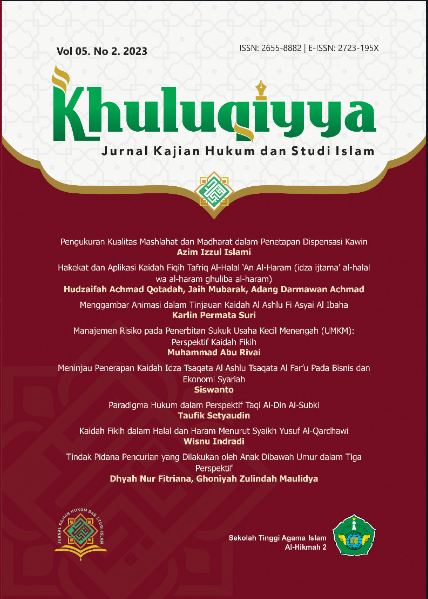
Pengukuran Kualitas Mashlahat dan Madharat dalam PenetapanDispensasi Kawin
DOI:
https://doi.org/10.56593/khuluqiyya.v5i2.113Abstract
Eventhough there are differences between hujjah principles of fiqh as theorem, judges at Religious Court (Indonesian Islamic Court) often citing
principles of fiqh that dismiss mafsadat as preference which called “dar’u al mafasid muqaddamun ala jalb al mashalih” for supporting arguments of
law as law reasoning in a case request for marriage dispensation. Underage marriage actually confronted between mashlahat and madharat all at
once. Application of principles of fiqh frequently done disproportionate and inappropriate so that it is not in line with the purposes of marriage
which suppose forming happy and lasting family (household) founded on belief in God Almighty. This research is a normative research with qualitative approach in the form of critical study in applicating mashlahah theory in judge’s decision on marriage dispensation that using principles of fiqh that dismiss mafsadat as preference, but has potential to deviate marriage’s purposes. The result of this research giving description and analysis towards potential’s quality of mashlahat and madharat that will be emerge from underage marriage. A judge must done identification thoroughly towards a child’s readiness to marry, whether there is duress or not and urge reasoning to marry. Comprehensive analytic towards those aspects will generate mashlahat and madharat analysis that measurable so that principles of fiqh that dismiss mafsadat as preference’s application become accurate, proportional and in line with sharia’s goals.
Downloads
References
Asy Syatibi, Abu Ishaq. (tt). al Muwafaqat fi ushul asy Syariat. Juz II. Mesir: Maktabah at Tijariyah
Kubra.
Asyur, Muhammad Thahir Ibn. (2001). Maqashid asy Syariah al Islamiyyah, cet. 2, ditahqiq oleh
Muhammad Thahir al Misawy. Jordania: Dar an-Nafa‟is.
Athiyyah, Jamaluddin. (2001). Nahwa Taf’il Maqashid as Syariah. Damaskus: Dar al Fikr.
Auda, Jasser. (2013). al Maqasid untuk Pemula, terj. Ali Abdelmon’im. Yogyakarta: SUKA Press.
Busyro. (2019). Maqashid al Syariah: Pengetahuan Mendasar Memahami Mashlahah, Jakarta:
Kencana.
Candra, Mardi. (2018). Aspek Perlindungan Anak Indonesia: Analisis tentang Perkawinan di
Bawah Umur. Jakarta: Kencana.
Fatwa Majelis Ulama Indonesia Nomor 11 Tahun 2012 tentang Status Anak Zina dan Perlakuan
Terhadapnya.
Fransiska Novita Eleanora dan Widya Romasindah Aidy. (2022). Monograf Perkawinan Anak.
Malang: Madza Media.
Haidar, Muhammad Aqil. (2018). Kaidah Fiqhiyah Sebagai Dalil. Jakarta: Rumah Fiqh Publishing.
Ibrahim, Duski. (2019). al Qawaid as Maqashidiyyah. Yogyakarta: ArRuzz Media.
Khallaf, Abdul Wahhab. (2005). Ilmu Ushul Fikih. Cet. 5. Terj. Halimuddin. Jakarta: Rineka Cipta.
Mahkamah Agung, Direktori Putusan Mahkamah Agung, pada situs https://putusan3.
mahkamahagung.go.id/.
Muhaimin. (2020). Metode Penelitian Hukum. Mataram: Mataram University Press.
Muhammad Fahrezi dan Nunung Nurwati. (April 2020). Pengaruh Perkawinan Di Bawah Umur
Terhadap Tingkat Perceraian. Prosiding Penelitian & Pengabdian Kepada Masyarakat Vol.
Nomor 1, https://doi.org/10.24198/jppm.v7i1
Nasution, Khoiruddin. (2004). Hukum Perkawinan I. Yogyakarta: ACAdeMIA dan Tazaffa.
Peraturan Mahkamah Agung Nomor 5 Tahun 2019 tentang Pedoman Mengadili
Perkara Permohonan Dispensasi Kawin.
Putusan Mahkamah konstitusi Nomor 22/PUU-XV/2017. Putusan Mahkamah Konstitusi Nomor
/PUU-VIII/2010.
Syarifuddin, Amir. (2009). Hukum Perkawinan Islam di Indonesia. Jakarta: Kencana Prenada
Media.
Umar, Mukhsin Nyak. (2006). Kaidah Fiqhiyyah dan Pembaharuan Hukum Islam. Banda Aceh:
Yayasan WDC.
Undang-Undang Nomor 1 Tahun 1974 tentang Perkawinan
Undang-Undang Nomor 16 Tahun 2019 tentang Perubahan Undang-Undang Nomor 1 Tahun 1974
tentang Perkawinan.
Zaprulkhan. (2020). Rekonstruksi Paradigma Maqashid asy-Syariah: Kajian Kritis dan
Komprehensif. Yogyakarta: IRCiSod.
Zein, Satria Effendi M.. (2005). Ushul Fiqh. Jakarta: Kencana.
Downloads
Published
How to Cite
Issue
Section
License
Copyright (c) 2023 Azim Izzul Islami

This work is licensed under a Creative Commons Attribution 4.0 International License.